2023年12月4日月曜日

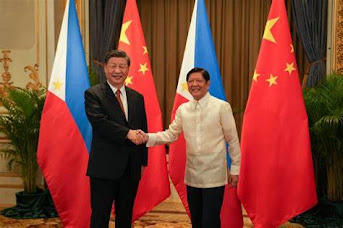
MEETS CHINA'S XI TO FIND WAYS TO REDUCE SOUTH CHINA SEA TENSIONS - PHILIPPINES' MARCOS

MEETS CHINA'S XI TO FIND WAYS TO REDUCE SOUTH CHINA SEA TENSIONS - PHILIPPINES' MARCOS 

@Jackie San

MANILA, November 18, 2023...

Philippine President Ferdinand Marcos Jr met with Chinese President Xi Jinping on Friday, seeking ways to reduce tensions in the South China Sea and restore Filipino fishermen's access to fishing grounds.


The Philippines and China need to continue to communicate, with the meeting a key part of the process to maintain peace, and keep open sea lanes and airways over the South China Sea, Marcos told reporters on the sidelines of the APEC Summit in San Francisco.


"We tried to come up with mechanisms to lower the tensions in the South China Sea," Marcos said, without elaborating.


Marcos said he voiced concern over incidents between Chinese and Philippine vessels, including one collision. He said he also raised the plight of Filipino fishermen.


"I asked that we go back to the situation where both Chinese and Filipino fishermen were fishing together in these waters," he said.


Filipino fishermen have complained that Chinese coastguard and maritime militia ships are preventing them from fishing in parts of the Philippines' 200-mile exclusive economic zone.


Marcos said he and Xi were in agreement that geopolitical problems should not be the defining element of the two countries' relationship.


Since taking office in 2022, Marcos has pursued warmer ties with the United States, a treaty ally, in contrast with the pro-Beijing stance of his predecessor.


Marcos granted the United States greater access to its military bases, including in provinces facing the South China Sea and democratically ruled Taiwan, drawing the ire of Beijing.


Tensions in the region, where China has built man-made islands with missiles and airstrips, have increased this year.


"I do not think anybody wants to go to war," Marcos said.


China claims almost the entire South China Sea, ignoring a 2016 ruling by the Permanent Court of Arbitration that invalidated Beijing's expansive claim.


China's embassy in Manila did not immediately respond to a request for comment.


>>>MORE ARTICLE JUST CLICK HERE<<<

https://www.jacknjillscute.com/2023/06/philippines-and-united-states-off.html

https://www.jacknjillscute.com/2023/03/philippine-governor-and-five-others.html

https://www.jacknjillscute.com/2023/03/condemns-chinas-aggressive-laser-use.html

https://www.jacknjillscute.com/2023/03/another-attack-in-philippines-aparri.html


@Jackie San


Ujikaji Bahan Kimia Sesuai Tenaga Diperbaharui... Gituwww

  https://youtu.be/BVfPkDcEYBY?si=giL_aVFXfSLbIppK

>>>MORE VIDEO JUST CLICK HERE FOR WATCHING<<<


2023年12月3日日曜日

WHAT CHINA'S XI GAINED FROM HIS BIDEN MEETING ?

WHAT CHINA'S XI GAINED FROM HIS BIDEN MEETING?

@Jackie San


SAN FRANCISCO/HONG KONG, November 16, 2023 - When Chinese President Xi Jinping met executives for dinner on Wednesday night in San Francisco, he was greeted with not one, but three standing ovations from the U.S. business community.


It was one of several public relations wins for the Chinese leader on his first trip in six years to the United States, where he and President Joe Biden reached agreements covering fentanyl, military communications and artificial intelligence on the sidelines of the Asia-Pacific Economic Cooperation summit.


ll three were outcomes the United States had sought from China rather than the other way around, said two people briefed on the trip.


But Xi appeared to have achieved his own aims: earning U.S. policy concessions in exchange for promises of cooperation, an easing of bilateral tensions that will allow more focus on economic growth, and a chance to woo foreign investors who increasingly shun China.


"We invite friends from business communities across the world to invest and deepen your footprint in China," he said at an APEC CEO summit, promising action on the list of items that irk foreign investors, from intellectual property theft to data security.


China's economy is slowing and earlier this month it reported its first quarterly deficit in foreign direct investment. And the ruling Communist Party has battled political intrigues that have raised questions about Xi's decision-making, including the sudden and unexplained removals of his foreign minister and defense minister.


"If the U.S. and China can manage their differences ... it will mean that Xi Jinping doesn't have to divert all of his attention to that (bilateral relations)," said Alexander Neill, an adjunct fellow at Hawaii's Pacific Forum think-tank.


"He needs to focus on his domestic agenda, which is incredibly pressing."


DROPPING SANCTIONS FOR COOPERATION


Securing Xi's promise of Chinese cooperation on stemming the flow of fentanyl to the United States was high on Biden's to-do list for the summit. A senior U.S. official said the agreement under which China would go after specific companies that produce fentanyl precursors was made on a "trust but verify" basis.


In return, the U.S. government on Thursday removed a Chinese public security forensic institute from a Commerce Department trade sanction list, where it was placed in 2020 over alleged abuses against Uyghurs, a long-sought diplomatic aim for China.


Critics warned removing sanctions against the institute signals to Beijing that U.S. entity listings are negotiable, and have questioned the Biden administration's commitment to pressuring China over what it says is the Chinese government's genocide of Uyghurs.


"This undermines the credibility of our entity list and our moral authority," said a spokesperson for the Republican-led House of Representative's select committee on China.


On top of that, Biden's Republican opponents argue the U.S. is missing an opportunity by not leveraging China's flagging economic momentum for more diplomatic gains.


Biden also touted as a success an agreement to resume military dialogues cut by China following then-U.S. House Speaker Nancy Pelosi's 2022 trip to Chinese-claimed Taiwan.


But while Beijing would welcome lower tensions, this is unlikely to change Chinese military behavior the U.S. sees as dangerous, such as intercepts of U.S. ships and aircraft in international waters that have led to a number of near-misses.


"China fears hotlines could be used as a potential pretext for a U.S. presence in areas it claims as its own," said Craig Singleton, a China expert at the Foundation for Defense of Democracies in Washington.


Biden administration officials have acknowledged that creating functional military relations won't be as easy as semi-regular meetings between defense officials.


"This is a long, hard, slow slog and the Chinese have to see value in that mil-mil before they'll do it. That's not going to be a favor to us," one senior Biden administration told Reuters in October in the run-up to the Xi-Biden meeting.


PARTNER AND FRIEND?


In his public remarks to Biden, Xi suggested China sought peaceful coexistence with the United States, and he told business leaders China was ready to be a "partner and friend" to the U.S., words partially aimed at a business community alarmed by China's crackdown on various industries and the use of exit bans and detentions against some executives.


Similarly, Xi's televised garden walk with Biden, and the largely respectful reception given to Xi by his American hosts, was highlighted in China's tightly controlled media to show a domestic audience that their president is managing the country's most important economic and political relationship.


"Xi Jinping may have made the calculation that overhyping the American threat does China and his standing in the party and the party itself more harm than good," said Drew Thompson, a former Pentagon official who is now a scholar at the National University of Singapore.


"The fact that we are debating whether China is investible is a real problem for China."


At the same time, Xi reiterated to Biden points that he made earlier this year to Russian President Vladimir Putin, urging the U.S. president to view U.S.-China relations through "accelerating global transformations unseen in a century."


Analysts say that is code for the belief that China - and Russia - are remolding the U.S.-led international system.


Still, this time pragmatism may have outweighed ideology.


China recognizes it's still necessary for its economic progress to have somewhat normal relations with the U.S. and Western countries, said Li Mingjiang, a professor at the Rajaratnam School of International Studies in Singapore.


"It's the fundamental driving force behind the meeting."


Reporting by Michael Martina and Greg Torode; Additional reporting by Antoni Slodkowski and Laurie Chen in Beijing; Editing by Don Durfee and Tom Hogue.


>>>READ MORE ARTICLE JUST CLICK HERE<<<

https://www.jacknjillscute.com/2023/04/china-deploys-warships-near-taiwan.html#google_vignette

https://www.jacknjillscute.com/2023/05/china-sets-up-no-fly-zone-near-taiwan.html

https://www.jacknjillscute.com/2023/06/beijing-need-to-stop-provocative-and.html

https://www.jacknjillscute.com/2023/08/cooking-gas-explosion-kills-about-31.html

https://www.jacknjillscute.com/2023/09/hong-kong-seafood-businesses-brace-for.html

https://www.jacknjillscute.com/2023/03/condemns-chinas-aggressive-laser-use.html


@Jackie San


Kumamoto Masters Series Japan 2023 Badminton FINAL Day #6

 
 https://youtu.be/gbgkjCFx2kg?si=4SYf4Nd9nyPAUjG5

>>>MORE VIDEO JUST CLICK HERE<<<


2023年12月2日土曜日

FACES 'FRIENDSHORING' DILEMMA IN ASIA AMID CHINA RISKS FOR JAPAN

FACES 'FRIENDSHORING' DILEMMA IN ASIA AMID CHINA RISKS FOR JAPAN

@Jackie San


A growing sense of urgency to ensure economic security is precipitating the formation of like-minded groups in the Asia-Pacific, where the reengagement of the United States is met with China's quest for greater influence.


The new paradigm is putting Japan's diplomacy -- and its ultimate vision for its own engagement in the region -- to the test.


It is pushing for a rules-based, "free and open" Indo-Pacific, seen as a counterbalance to China, but it also needs to avoid alienating countries that are much closer to Beijing than to Tokyo and ruffling the feathers of the Asian powerhouse.


The delicate balancing act was evident when Japanese Prime Minister Fumio Kishida visited San Francisco for a summit of the Asia-Pacific Economic Cooperation forum that concluded Friday. He underscored the importance of allies and partners joining forces, and in particular, warming relations with South Korea as they both face China, an assertive neighbor but key trading partner.


At the summit of the Indo-Pacific Economic Partnership coinciding with APEC, Japan and 13 other nations reached agreement on all but one pillar of the U.S.-led trade initiative that does not include tariff cuts like free trade agreements, a key step toward what the United States terms "friendshoring," or diversifying supply chains among like-minded partners.


"It's a framework that is designed to protect the economic security of the United States, which will also benefit Japan and other nations," said Junichi Sugawara, a principal at Owls Consulting Group. "But it's not as if we are going to completely decouple from China so the question is how far friendshoring can go."


Some experts see the momentum building for a more fragmented world in which states defend their own national interests, in a potential blow to multilateral, free trade arrangements.


As talks continued to complete as many pillars of the IPEF as possible, a Japanese government official said reducing reliance on a single nation for strategically critical items was a "good" course of action.


"That being said, it does not and should not mean that partners with similar views can also undermine the free trade system," the official added.


Japan enjoyed the benefits of free trade during its high growth era with bilateral and multilateral agreements.


Even without the participation of the United States, Japan pushed for the conclusion of the Trans-Pacific Partnership agreement, while joining the Regional Comprehensive Economic Partnership, which also involves China, South Korea and the 10-member Association of Southeast Asian Nations.


APEC members also share the ambitious goal of creating an Asia-Pacific free trade area.


During the years of the COVID-19 pandemic, shortages of goods, notably chips, made some nations more inward-looking. "With supply chains disrupted and goods not coming in, people started looking at (the importance of) their own national borders," Sugawara said.


Still, economic benefits are bringing countries closer like Japan and South Korea, which were until recently unlikely bedfellows due to differences over wartime labor compensation and other issues.


In a rare joint appearance with South Korean President Yoon Suk Yeol at a Stanford University event, Kishida spoke of the need for Japan, South Korea and the United States to jointly drive transformations.


"It's natural that South Korea is getting closer to Japan and the United States because it has been taking a big hit from this U.S.-China rivalry," said Toru Nishihama, chief economist at Dai-ichi Life Research Institute. "But this is happening under the conservative government and it could change if the leader changes."


Trilateral cooperation between Japan, China and South Korea is also necessary given their economic interdependence but has become increasingly complex, especially with Tokyo and Seoul pushing for cutting reliance on China, or de-risking. Eyes are on whether the three nations will be able to hold their first summit in four years, with South Korea this year's chair of the tripartite framework.


For Japan, ASEAN members are crucial for a loose coalition of partners to help make the region free and open without raising the ire of China. Brunei, Indonesia, Malaysia, Singapore, Thailand, the Philippines and Vietnam have joined IPEF.


Some others like Cambodia are closer to China than to the United States or Japan, and experts say forcing the ASEAN members to choose between the two camps will not work.


With China in mind, Japan has made it a point to call for a rules-based international order.


Mie Oba, a professor of international relations at Kanagawa University, said Japan needs to be more specific in its vision for the region, as in its recent plan for the creation of a zero-emission community in Asia.


"Be it IPEF or RCEP, countries in the region will use it if it benefits them," Oba said. "The important point is how Japan will figure in the region and within multilateral arrangements over the longer term and that should be visible."

>>>READ MORE ARTICLE JUST HERE<<<

https://www.jacknjillscute.com/2023/10/typhoon-kanun-kills-two-in-okinawa-at.html

https://www.jacknjillscute.com/2023/11/japans-self-defense-forces-struggling.html#google_vignette

https://www.jacknjillscute.com/2023/11/number-of-foreign-residents-in-japan.html

https://www.jacknjillscute.com/2023/11/iaea-japan-agree-on-continuos-safety.html


@Jackie San

2023年12月1日金曜日

FINAL Kumamoto Masters 500 Series Japan 2023 Day #6

  
https://youtu.be/L_tt-AF4SP4?si=-Gbn3nUMBYpjMKnL

>>>MORE VIDEO JUST CLICK HERE FOR WATCHING<<<


WHY THAILAND'S THRIVING BOYS LOVE CULTURE DRAMA MOST POPULAR NOW A DAY ?

WHY THAILAND'S THRIVING BOYS LOVE CULTURE DRAMA MOST POPULAR NOW A DAY?

@Jackie San


"The presence of Boys Love Series, a unique drama genre that depicts homoerotic relationships between male characters, has increased significantly in recent years. Narratives revolving around two boys in a romantic relationship were pretty much secondary subplots before the 2014 series LOVE SICK (THAILAND DRAMA) which was a significant turning point for the subgenre. It was probably the first time in Thailand entertainment history that two boys homosexual inclinations were featured in the lead."


It begans...For many of us, Friday nights during the lockdown meant binge-watching new programs on Netflix. But for millions of Boys Love (“Y” in Thai) fans around Asia, it was one night to fix their eyes on the screen to watch the latest episode of 2gether: The Series, unarguably Thailand’s most popular Boys Love drama. 


Throughout the 13 weeks of its airing, the #2gethertheSeries hashtag topped global trends on Twitter—the most favored social media of Boys Love fans—and triggered millions of virtual conversations about the series in various languages, from Thai to Chinese to English. The series was so popular that its lead actors, fresh-faced Vachirawit “Bright” Cheva-aree and Metawin “Win” Opas-iamkajorn, garnered more than a million Instagram followers from all over the world in just a few weeks. 2gether: The Series became the global phenomenon no one expected.


WHEN BOYS LOVE BOYS !

The presence of Boys Love series, a unique drama genre that depicts homoerotic relationships between male characters, has increased significantly in recent years. Narratives revolving around two boys in a romantic relationship were pretty much secondary subplots before the 2014 series Love Sick, which was a significant turning point for the subgenre. It was probably the first time in Thai entertainment history that two boys with homosexual inclinations were featured in the lead.

Since then, other players in the market jumped in, including GMMTV, a subsidiary of Thailand’s largest entertainment conglomerate, GMM Grammy, and producer of 2gether: The Series.

"BACK THEN, IT WAS CONTROVERSIAL FOR A MAJOR ENTERTAINMENT COMPANY TO PAIR UP TWO GUYS"

Noppanat Chaiwimol, a director and producer for GMMTV (pictured above), tells us that the company first chose a less obvious course by dropping in Boys Love characters into heterosexual series (Tay-New from Kiss and Pik-Low from Senior Secret Love, for example). After gaining positive feedback, the entertainment powerhouse decided to go all the way. Sotus was its first try. “The first [season] was an experiment. We didn’t know how would it go,” says the young exec. “Back then, it was controversial for a major entertainment company to pair up two guys. Well, it turned out to be a big hit and Chris-Singto [the portmanteau for the actors in the series] are still around today even if it’s been about four or five years.”


LINE TV, the free streaming platform that has been broadcasting Boys Love series such as Make it Right and Sotus since 2016 says that the coronavirus lockdown earned the platform the biggest increase in viewership in history. From a five percent audience share in 2019, the first quarter of 2020 alone saw the number peaked at 34 percent. “Boys Love is no longer a sub-genre. It’s gone mainstream,” says Kanop Supamanop, LINE’s VP for content business. LINE TV alone currently stockpiles 33—and counting—Thai Boys Love series on its platform, making it the biggest producer of the subgenre in Thailand.

READING LOVE BETWEEN THE LINES !


Like many Boys Love dramas before it, 2gether the Series is based on a novel of the same name.


Thai Boys Love is a local appropriation of yaoi, the Japan-originating form of homoerotic fiction that revolves around the romantic narratives between a masculine boy (called “uke”) and a more feminine boy (called “seme”). Traditionally, yaoi is created, consumed and favored by women. This Japanese subculture arrived in Thailand a decade ago in the form of novels. The community of Boys Love readers flourished long before the culture came to the small screen.

"THE GENRE PICKED UP AND BLOSSOMED IN AROUND 2014-2015"

“It started off underground, before surfacing around 2011 to 2012. The genre picked up and blossomed in around 2014-2015,” says Dr. Utain Boonorana, a medical doctor who’s also an LGBTQ fiction author known by his pseudonyms, Patrick Rangsimant and Mor Tood (“Homo Doctor” in Thai). The Boys Love novels he penned include My Ride, I Love You, which has been translated into English and is set to become a TV drama.    

"SOCIAL SEEMS TO BE MORE ACCEPTING OF BOYS LOVE FICTION IN THAILAND"

Walk into any major bookstores in Bangkok—as well as other major provinces—now and you’ll see what would have been unheard of a few years back: Boys Love novels taking over more and more shelves. 


Observing the growth of Boys Love literature, decades-old publishing house Sataporn Books jumped onto the bandwagon in 2018 and launched a new brand called Deep. So far, Deep has published around 70 Boys Love titles, and 20 of them being produced into a television series. “I guess society seems to be more accepting of Boys Love fiction,” says Jetiya Lokitsataporn, the owner of Sataporn Books. She goes on to explain that the Boys Love industry has seen tremendous growth because more producers, including major channels, have shown interest in turning these novels into television series. More series translates into better sales of the books.


Jetiya also points out that she has seen fewer stories about students and more about people with actual careers. “There is also more fantasy fiction, like those in which men could become pregnant. If you treat them as fantasy, we could simply accept them [as entertainment].” Deep is also selling the rights to their novels to international publishers in Taiwan, Japan, and Korea.

THE (CLICHED) FORMULA THAT GUARANTEES SUCCESS !


Similar to many other successful Thai Boys Love media, 2gether:The Series centers around college students living out unreal storylines and engaging in somewhat irrational conversations. It’s these elements that seem to guarantee the success of a Boys Love series—in addition to attractive characters with on-screen chemistry, that is. Other hit series such as TharnType and En of Love also fall into this cliché. 


“Most readers and authors are teenagers, so life in college is what’s closest to their real life,” says Utain, adding to the premise. “Pre-teens and teens [which are Boys Love’s main target groups] would not be able to understand how a frustrated 30-something woman actually feels about life…they won’t be able to empathize.”

"WE FIND BOYS LOVE CHARACTERS REFLECT THE DESIRES OF A YOUNG WOMAN"

Curiously enough, Boys Love protagonists all come from the same demographic. A parody on the sub-culture pointed out that most lead characters are either engineering or medical students from affluent backgrounds.


PhD researcher Ronnayuth Euatrirat, who’s studying the Thai Boys Love phenomenon, explains that this may be due to the fact that many Boys Love novels are penned by female authors. “We find Boys Love characters reflect the desires of a young woman. An engineering student, for example, is a typical desirable personification of a dependable man. These characters also have a manly appearance and come from well-to-do backgrounds. These standards respond to women’s needs.” 


GMMTV, now the best-known producer of Thai Boys Love series, is taking a risk by tweaking these clichéd standards. Later this year, it will release A Tale of Thousand Stars, its first Boys Love series that doesn’t feature a teen, nor an engineering student, in the lead. Instead, you have a budding relationship between a volunteer teacher and a forestry officer. Noppanat, who is writing the screenplay and is directing the series, wants to explore new possibilities in the Boys Love landscape. Though the series’ has yet to be aired, previews have received positive feedback from Boys Love fans that are starting to get fed up with teenage fantasies.

LGBT AND BOYS LOVE : TWO PARALLEL UNIVERSES ?


The wide reception and popularity of Thai Boys Love owes so much to the freedom of gender expression in Thailand. But is the LGBTQ community actually benefiting from the increasing popularity of Boys Love novels and series?


A number of local LGBTQ advocates have shunned Boys Love culture, saying that it doesn’t reflect the real lives of LGBTQ individuals, and even portrays a false perception of the community. But the experts we’ve spoken with don’t wholly agree.


Noppanat acknowledges that this is one topic you can spend days discussing. The veteran producer and director, who has been doing research on Boys Love for more than five years, doesn’t think these series are “too fantasized” and are not an appropriate reflection of the LGBT community.

"MANY LGBT INDIVIDUALS POSSIBLY LIVE THEIR LIVES LIKE THOSE [IN BOYS LOVE SERIES]"

“All Boys Love dramas revolve around same-sex relationships so, personally, I think they represent diversity. They are a sub-part of the LGBTQ genre. However, at the end of the day, we’re talking about the Boys Love genre that focuses on romantic fantasy and not more serious LGBTQ issues such as equality and HIV. Being in the middle of this lengthy discussion for so long, I have had to find the right balance between what the audience needs and what needs to be done,” he explains. “Many LGBT individuals possibly live their lives like those [in Boys Love series]. You see young same-sex couples everywhere, right? Society is now more open and they might not have to overcome many obstacles like those before them. So if you take this case into account, Boys Love series could be real [examples of society].


An LGBTQ advocate himself, Nopparat tries to inject a message about gender acceptance into every Boys Love series he produces. He’s also the mind behind GMMTV’s LGBTQ productions, many of which have been praised for their complex and thought-provoking narratives, including Gay OK Bangkok. “We see new narratives, more diversity popping up every day. For example, I’m really interested in the gender fluidity young people are talking about these days. The world of LGBTQ is sensitive and needs further exploration.”

THE BUTTERFLY EFFECT : THE UNEXPECTED CONSEQUENCES OF POPULARITY


A few months ago, one of 2gether: the Series’ young lead stars posted comments on social media that allegedly criticized China’s power over Hong Kong and Taiwan. Though his comments were clearly misconstrued and taken out of context, it didn’t stop a full-blown war from exploding on Twitter. Thai and Chinese users, Boys Love fans and just simple detractors alike, exchanged insults. It wasn’t too long until Hong Kongers and Taiwanese weighed in and banded together with the Thais in a digital coalition called “Milk Tea Alliance.” Even famous Hong Kong political activist Joshua Wong showed his support for the affiliation.


When the Embassy of China in Thailand issued a statement on its Facebook Page (which wasn’t received well by netizens), everyone knew things had gone out of control. The controversial issue went on to make the headlines of many news agencies, including Reuters.


But like everything else in the Twitter universe, the fire was doused as quickly as it sparked. After a few weeks, the online dispute died down, but it did leave the series more popular than ever.

SOF POWER IN THE MAKING


Exercising a nation’s culture as “soft power,” a persuasive, indirect international relation tool, has become a common practice worldwide. For example, K-pop has been one of South Korea’s key export products for years, making waves—and money—across the world. In 2018, it was reported that Korean cultural content exports were worth US$9.55 billion.


Similarly, Thai Boys Love is becoming more popular across the region, but could it become so influential as to affect pan-national relations and eventually evolve into Thailand’s new soft power?


“South Korea is exporting K-pop culture and, you know what, we are now exporting Boys Love series,” Utain says, adding that Boys Love fans around the world have praised Thai versions as some of the world’s best. “There are communities that monitor Thai Boys Love series. There could be a new Facebook Page popping up right following the news about the release of a new Boys Love series.” 

"SOUTH KOREA IS EXPORTING K-POP CULTURE AND, YOU KNOW WHAT, THAILAND NOW EXPORTING BOYS LOVE SERIES"

Shortly after 2gether: the Series ended, GMMTV announced a series of virtual fan meetings featuring lead actors from its other Boys Love series—moderating in various languages, no less. Tickets were sold worldwide. You don’t have to be an economist to say GMMTV will definitely be bagging a hefty profit.


“I’m very confident in the quality of Boys Love series produced by many Thai production companies. 2gether the Series, for example, has proven successful,” says Noppanat. “It was the first time we saw opportunities in new markets: South America, Europe, the western hemisphere. 2gether the Series was the case study for us all [to prove] that it could go beyond Boys Love fans.”

>>>MORE ARTICLE JUST CLICK HERE FOR READ<<<

https://www.jacknjillscute.com/2023/03/thailand-hot-guy-event-cancelled-after.html

https://www.jacknjillscute.com/2023/06/squaring-circle-of-same-sex-marriage-in.html#google_vignette

https://www.jacknjillscute.com/2022/12/two-indonesian-soldiers-get-7-months.html

https://www.jacknjillscute.com/2023/09/indonesia-lgbtq-event-moved-after.html

https://www.jacknjillscute.com/2023/09/japans-supreme-court-makes-landmark.html

https://www.jacknjillscute.com/2023/10/court-rejects-damages-claim-by-woman.html


@Jackie San


Featured post

HIKONE CASTLE - JAPAN NOMINATE FOR 2028 WORLD HERITAGE LISTING - TOKYO JAPAN

HIKONE CASTLE - JAPAN NOMINATE FOR 2028 WORLD HERITAGE LISTING - TOKYO JAPAN @Jr_Paku Midin Channel TOKYO The Japanese council for cultural ...